Why Your Posture Is Probably Worse Than You Think
Here's a sobering reality: most of us spend between 9 and 12 hours a day sitting. Whether it's at a desk, in a car, or on the couch, our bodies are constantly adapting to positions that were never designed for long-term habitation. The result? Rounded shoulders, a forward-jutting head, a compressed lower back, and a core that has essentially gone to sleep.
The good news is that posture is not fixed. It's a habit — and like any habit, it can be changed. And there may be no better tool for that change than a consistent Pilates practice.
What Does Good Posture Actually Mean?
Before we can improve our posture, we need to understand what we're aiming for. Good posture isn't about standing ramrod straight like a soldier. It's about neutral alignment — a state in which your spine maintains its natural curves, your joints are stacked efficiently, and your muscles aren't working overtime just to keep you upright.
In neutral alignment, your ears sit over your shoulders, your shoulders sit over your hips, and your hips sit over your ankles. Your spine has a gentle S-curve — not flat, not exaggerated — that acts as a natural shock absorber for daily movement.
How Pilates Improves Posture at the Root
Unlike quick fixes like posture corrector braces or reminders to "sit up straight," Pilates addresses posture from the inside out. Here's how:
It Strengthens the Deep Stabilizers
The muscles most responsible for holding you upright aren't the big, visible ones — they're the deep stabilizers: the transversus abdominis, multifidus, and deep neck flexors. Pilates systematically activates and strengthens these muscles through controlled, intentional movement. When these muscles are strong and responsive, good posture becomes the path of least resistance.
It Lengthens What's Tight
Poor posture isn't just a strength problem — it's also a flexibility problem. Prolonged sitting shortens the hip flexors, chest muscles, and upper trapezius. Pilates incorporates regular spinal articulation, hip opening, and thoracic extension work that counteracts these patterns and restores natural length to overworked tissues.
It Builds Body Awareness
Perhaps most powerfully, Pilates trains your proprioception — your body's internal sense of where it is in space. Over time, you begin to notice when you're collapsing into a slouch, when your head is drifting forward, or when you're holding tension in your shoulders. This awareness is the first step to lasting change.
Key Pilates Exercises for Better Posture
If you're looking to improve your posture with Pilates, these exercises are your best starting point. (For a complete introduction to foundational Pilates movements, explore our post on 5 Essential Pilates Exercises for Beginners.)
1. Spine Stretch Forward
Sit tall with your legs extended and arms reaching forward. Exhale as you round your spine forward, reaching your fingertips past your feet. Inhale to return to tall sitting. This exercise lengthens the entire posterior chain and reinforces the habit of initiating movement from a tall, elongated spine.
2. Swan Prep
Lying face down with hands under your shoulders, gently press up into a gentle backbend, keeping your elbows slightly bent and your pelvis grounded. Hold for a breath, then lower with control. Swan Prep is one of the most effective antidotes to the forward-hunched posture created by screen time.
3. Chest Lift with Rotation
Lying on your back with knees bent, interlace your fingers behind your head. Curl your head and shoulders off the mat, then rotate your ribcage toward one knee while keeping your elbows wide. This targets the obliques while also mobilizing the thoracic spine — a notoriously stiff area in desk workers.
4. Standing Wall Work
Stand with your back against a wall, heels a few inches away from the baseboard. Try to get the back of your head, shoulders, and sacrum to touch the wall simultaneously. Hold this position for 60 seconds while breathing naturally. This simple exercise trains the nervous system to recognize what proper alignment actually feels like.
5. Hip Flexor Stretch with Reach
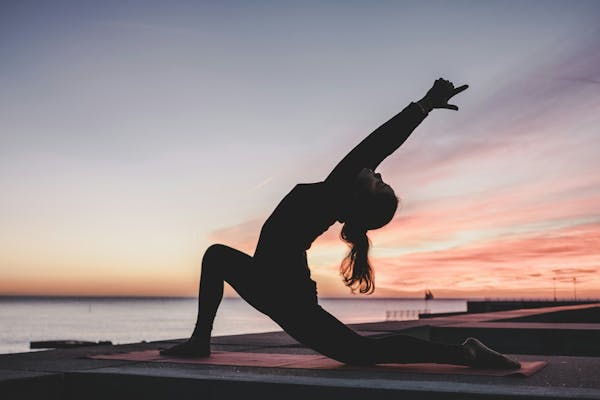
From a kneeling lunge position, tuck your pelvis gently and reach your arms overhead. Breathe into the front of your hip and chest simultaneously. Tight hip flexors pull the pelvis forward and compress the lower back — releasing them is non-negotiable for anyone wanting to stand and move more freely.
How Often Should You Practice for Posture Results?
Consistency is the key. You don't need hour-long sessions to see results — in fact, shorter, more frequent practices often produce faster posture improvements because they reinforce new movement patterns more regularly.
- Beginners: Aim for 3 sessions per week, 20–30 minutes each
- Intermediate practitioners: 4–5 sessions per week, mixing mat and equipment work
- For desk workers: Add a 5–10 minute "posture reset" routine at midday, even on non-Pilates days
The science of motor learning tells us that repetition is how new movement habits get wired into the nervous system. The more often you practice neutral alignment, the more natural it becomes — on and off the mat.
What to Expect on Your Posture Journey
Many students notice small but meaningful shifts within the first 2–4 weeks of consistent Pilates practice. You might catch yourself sitting taller at your desk, or notice that your shoulders no longer creep up toward your ears during stressful moments. These micro-shifts are signs that your nervous system is beginning to update its default settings.
By weeks 6–8, the changes tend to become more visible and more durable. People around you may comment that you seem taller, more confident, or more at ease in your body. And the wonderful thing about posture improvement is that it's self-reinforcing: as your alignment improves, daily activities require less effort, which means less fatigue, less tension, and less pain.
For those dealing with chronic lower back discomfort or postural pain, Pilates can be especially beneficial as part of a broader rehabilitation approach. (You might also find it helpful to explore our deep dive into The Science Behind Pilates Core Training for the anatomy behind why this works.)
Start Rebuilding Your Posture Today
Your posture tells a story about how you've been living in your body. The beautiful thing is, that story isn't finished — and Pilates gives you the tools to write a new chapter.
Whether you're dealing with years of desk-related tension or simply want to move through the world with more grace and ease, a mindful Pilates practice can get you there. Start with the exercises above, commit to consistency, and pay attention to how your body responds. The results may surprise you.
Ready to begin? I'd love to guide you through a personalized practice designed around your posture goals. Reach out today and let's start building the foundation your body deserves.
Written by
Sarah Spiro
Certified Pilates Instructor
Sarah is a certified Pilates instructor with over 10 years of experience helping clients transform their bodies and minds through mindful movement. She specializes in rehabilitation Pilates and mindful movement practices.